A picture of a man with a beard and glasses.
A picture of a man with glasses on.
A blurry photo of a woman's face.

Trusted by 100+ Clients Worldwide

AI Development Company for Custom and Enterprise AI Solutions

We've shipped over 100+  AI models across healthcare, construction, and manufacturing. If your team is still running on manual workflows and gut-feel decisions, we can change that without replacing your existing stack.

Book Your Free AI Consultation
Svg Icon
Svg Icon
Svg Icon
Svg Icon
A blue circular object with a white background.
About us

NeuraMonks Trusted AI Development Partner

Your strategic partner for custom AI from clarity and design to seamless enterprise deployment.

20+

Industries Accelerated

48+

AI & Cloud Specialists

08+

Years of AI Expertise

2+

Strategic Global Partnerships

5+

Countries Served

200+

AI Models in Production

100+

Happy Clients Worldwide

Success Stories

AI Case Studies

As a custom AI Solutions company, we've engineered features that will actually make a difference to your business.

GIF

Converts raw image into editable floor plans, explore renovation ideas, and seamlessly turn concepts into reality

Supplier Connectivity

Reach 30% more qualified suppliers, faster.

Comprehensive Planning

See your renovation in 3D with 50% less effort.

Efficient Management

Accelerate project planning by up to 45%.

A plane flying in the sky at night.

Dive into videos with dynamic, interactive segments—explore, customize, and engage with content tailored just for you.

Interactive Navigation

Explore video paths with 30–40% deeper engagement

Customizable Experience

AI-generated paths cut effort by 55–65%

Engaging Storytelling

Scale storytelling with 35% more engagement depth.

Monotype AI font recognition demo — real-time matching at scale

Streamlined COVID Testing with Secure Results Management for Safer Travel.

AI-Powered Font Recognition

Real-time font detection with 80% Top-10 accuracy at massive scale.

Scalable Matching Engine

Onboard 100% new fonts without retraining, enabling 40% faster scaling.

Design-Centric Integration

Deliver 95% precision with 30% smoother UI integration

A plane flying in the sky at night.

Create standout resumes with ATS Scoring, match them to jobs, and manage updates with ease.

AI Product Advisor

Recommends from 30,000+ fishing products, cutting discovery time by 40 to 50%.

Domain-Trained Chatbot

Delivers expert-level guidance with 30 to 40% higher buyer confidence.

Sales-Driven Suggestions

Boosts ecommerce conversions by 20 to 30% and reduces decision fatigue

Our Clients See 30 to 40% Efficiency Gains Within 90 Days

That's not a projection it's the average across 100+ AI deployments. We'll build your custom AI roadmap with real numbers tied to your operations, not generic industry benchmarks.

Get My AI Roadmap
AI Solutions
Why Choose Us

Why Global Enterprises Choose NeuraMonks for AI Solutions

About us

30–40% Efficiency-Driven AI Execution

We build AI that delivers results, not experiments. From strategy to deployment, we own 100% execution driving 30 to 40% efficiency gains within the first 90 days.

About us

6+ Industry AI Expertise

AI solutions across 6+ industries, reducing implementation risk by 25% with proven frameworks.

About us

99.9% Uptime Global Deployments

Our AI systems run across regions with 99.9% uptime, ensuring secure, consistent performance for distributed enterprise teams worldwide

About us

Speed Without Compromise

We take AI from idea to production in 4 to 8 weeks, helping enterprises launch 50% faster without compromising quality or accuracy.

About us

Business-First Architecture

Every project is led by senior AI architects, aligning technology with growth, automation, and cost savings delivering 20 to 35% operational cost reduction.

About us

90%+ ROI-Focused AI Delivery

Over 90% of our AI projects scale from pilot to production because we deliver AI that works and generates measurable ROI.

Our Clients

What Leaders Say About us

Real results from real clients. These aren't projections they're measured outcomes from deployed systems.

Recognized by

GoodFirms Review
Clutch Review
Google Review
ISO Certificate
SOC2 Certified
Red location pin icon

100% Confidential & NDA-Protected

AI That Stays Sharp. Because Models Drift, We Don’t.

Backed by 48+ dedicated engineers, we provide live monitoring and proactive retraining across 200+ active deployments. With 8 years of infrastructure expertise, we catch performance drift before it hits your users keeping downtime at near zero.

AI Solutions
Services

End-to-End Delivery Led by a Comprehensive AI Solutions Provider

From your first idea to a live, revenue generating AI system we handle every phase.

Svg Icon

AI Readiness Assessment

Evaluate your organization’s data, processes, and tech maturity.

Use Case Identification

Pinpoint AI initiatives that deliver maximum business value and operational efficiency.

Technology & Infrastructure Planning

Make sure your systems are prepared for the scale of artificial intelligence.

Implementation Strategy

Map actionable steps for fast, risk-free deployment.

Risk & Compliance Analysis

Risk & Compliance Analysis: Guarantee security, governance, and regulatory alignment.

Svg Icon

Prototype Development

Build AI-driven prototypes to validate your concept.

Feasibility Analysis

Assess the technical and business feasibility of your idea.

Market Validation

Conduct real-world testing to evaluate user demand.

Technology Stack Selection

Choose the best frameworks and tools for implementation.

Performance Benchmarking

Compare with industry standards to ensure effectiveness.

Svg Icon

Rapid Development

Build and launch a functional AI-driven MVP swiftly.

Core Feature Integration

Focus on essential functionalities for initial testing.

User Feedback & Iteration

Gather insights to refine the product.

Scalability Planning

Ensure a smooth transition from MVP to full-scale product.

Deployment Readiness

Prepare for real-world application and market launch.

Svg Icon

End-to-End AI Solutions

Comprehensive development from ideation to execution.

Custom AI Models

Tailor-made AI models for unique business requirements.

Wrapper Creation

Build API wrappers and middleware to integrate AI into your existing systems.

Performance Optimization

Ensure high efficiency and accuracy.

Security & Compliance

Implement best practices for data protection.

AI Readiness Assessment

Evaluate your current setup to determine AI implementation feasibility.

Use Case Identification

Discover the best AI applications tailored to your business needs.

Technology & Infrastructure Planning

Design a scalable and efficient AI architecture.

Implementation Strategy

Create a step-by-step roadmap for smooth AI adoption.

Risk & Compliance Analysis

Ensure data security, regulatory compliance, and ethical AI practices.

Prototype Development

Build AI-driven prototypes to validate your concept.

Feasibility Analysis

Assess the technical and business feasibility of your idea.

Market Validation

Conduct real-world testing to evaluate user demand.

Technology Stack Selection

Choose the best frameworks and tools for implementation.

Performance Benchmarking

Compare with industry standards to ensure effectiveness.

Rapid Development

Build and launch a functional AI-driven MVP swiftly.

Core Feature Integration

Focus on essential functionalities for initial testing.

User Feedback & Iteration

Gather insights to refine the product.

Scalability Planning

Ensure a smooth transition from MVP to full-scale product.

Deployment Readiness

Prepare for real-world application and market launch.

End-to-End AI Solutions

Comprehensive development from ideation to execution.

Custom AI Models

Tailor-made AI models for unique business requirements.

Wrapper Creation

Build API wrappers and middleware to integrate AI into your existing systems.

Performance Optimization

Ensure high efficiency and accuracy.

Security & Compliance

Implement best practices for data protection.

Advanced AI Capabilities

Custom AI Solutions Built for Business Growth

We deliver Enterprise AI Solutions designed for real-world performance — secure, scalable, and aligned with operational and revenue objectives.

An image of a blue and pink circle.
Industries

AI Expertise Across High Value Sectors

We work in industries where AI delivers clear, measurable ROI not theoretical gains.

Our Clients

Explore Our Alliances

Clients, stakeholders, and partners empowering technology to work in the real world!

Our Partners

Strategic Partnerships That Drive Innovation

The microsoft azure logo on a green background.
The hewlett packard enterprise logo.
AI Insights & Resources

Ideas. Insights. Innovation.

From AI Solutions and AI/ML company rankings to Agentic AI and automation strategies our latest blogs give you the clarity and confidence to make smarter AI decisions.

Healthcare agencies

How Healthcare Agencies Cut Operational Costs by 40% and What it Actually Takes to get There

US healthcare agencies are cutting operational costs by up to 40% by deploying AI across revenue cycle management, clinical documentation, imaging diagnostics, and scheduling this post breaks down exactly where those savings come from, the implementation timeline, and 2026 pricing benchmarks for getting there.

Ketan Kanjiya

Ketan Kanjiya

10 Min Read
All
AI in Healthcare

US healthcare spends over $1 trillion a year on administrative and operational overhead. The agencies pulling ahead in 2026 are not the ones with the largest budgets they are the ones that deployed AI healthcare solutions where the costs are highest and measured results before expanding.

That 40% figure is not an estimate. It is a compounded number: efficiency gains stacked across seven operational layers, each independently measurable, each independently achievable. This post breaks down exactly where those savings come from, the use cases producing the clearest ROI, and what a realistic implementation looks like.

Where are the costs actually coming from

A mid-size hospital's operationloverhead breaks down across seven departments. The table below maps each to its primary AI application, the average cost reduction documented across 2025–2026 US deployments, and the implementation effort required.

Stack four of these and 35–40% total reduction is not aggressive it is conservative.

The six areas with the clearest ROI

1. Revenue cycle management

Claim denials cost US hospitals an estimated $262 billion per year. The causes missing data, coding errors, eligibility gaps are almost entirely preventable. AI healthcare solutions deployed in revenue cycle pre-validate claims against payer rules before submission, flag high-risk claims for human review, and automate prior authorisation follow-ups.

One Neuramonks client in orthopedics reduced their claim denial rate from 11.4% to 2.6% within six months recovering $3.2M in annual revenue from that single change.

2. Intelligent scheduling and patient flow

No-show rates in US healthcare average 18–23%. AI scheduling systems predict no-show likelihood per patient and appointment type with 84%+ accuracy, auto-fill cancellations from a prioritised waitlist, and reduce wait times by 30 to 40%. For health systems managing thousands of weekly appointments, scheduling optimisation alone generates $500K to $2M in recovered annual revenue.

3. Ambient clinical documentation

Physician burnout costs US healthcare $5 billion annually. Documentation SOAP notes, referral letters, discharge summaries consumes two to three hours per physician per day. Ambient AI transcription listens to patient-physician conversations (with consent), generates structured notes in real time, and pushes completed documentation to the EHR.

Physicians review and sign. Documentation time drops by 60–70%.

4. Medical imaging diagnostics with deep learning

Deep learning models detect, classify, and measure clinical findings in radiology scans, pathology slides, wound photos, and retinal images at speeds and levels of consistency that are difficult to match in manual workflows. This is one of the fastest-growing areas of artificial intelligence in healthcare.

Key imaging use cases producing documented ROI:

  • Radiology & lesion detection: CT/MRI scan analysis with bounding-box measurement flags findings for radiologist review, reducing review time by up to 60%.
  • Wound detection & progression tracking: Automated area measurement and week-on-week comparison, eliminating manual assessment time and improving care consistency.
  • Retinal screening: Diabetic retinopathy grading at scale, 3× more patients screened per clinician per day.
  • Pathology & histology classification: Tissue analysis and cancer risk stratification from slide images, with 94% AI diagnostic accuracy versus 78% manual on comparable tasks.

Neuramonks built an Automated Wound Detection and Measurement System using deep learning that enables clinical staff to document, measure, and track wound progression at scale  reducing assessment time and improving care consistency across multi-site operations.

5. Supply chain and inventory intelligence

Manual par-level management fails in high-volume environments. AI-powered supply chain systems predict consumption by department and patient census, auto-trigger purchase orders at optimal reorder points, identify substitution opportunities when items are backordered, and flag vendor pricing anomalies in real time. Hospitals using these tools report 8 to 14% reductions in supply expenditure without affecting care quality.

6. AI-assisted compliance and medical coding

Undercoding leaves revenue on the table. Overcoding creates audit risk. Manual workflows produce 80 to 85% coding accuracy. AI coding assistants read clinical documentation, recommend complete ICD-10/CPT code combinations, and flag documentation gaps before a claim is filed. AI-assisted rates reach 94 to 97%.

That It Actually Takes to Get There

There is a clear pattern separating agencies that get results from those that run pilots that quietly disappear. When evaluating how Neuramonks approaches choosing an AI solutions partner for US healthcare, achieving a true 40% reduction always requires anchoring your execution strategy around four critical pillars:

  1. Strict Data Security & Privacy: Systems must utilize fully HIPAA-compliant pipelines. Data must be encrypted in transit and at rest, utilizing zero-data-retention APIs to ensure patient health information (PHI) is never used to train public models.
  2. De-siloed Infrastructure: The AI shouldn't act as another isolated dashboard. It must connect directly into existing EHR and billing infrastructures (like Epic, Cerner, or Athenahealth) via secure, real-time APIs to enhance workflows where staff already work.
  3. Clinical-in-the-Loop Validation: AI should never operate fully autonomously in clinical decision-making. True success relies on a "Human-in-the-loop" model the AI acts as an accelerator, but qualified administrative or clinical staff retain final sign-off and override capabilities.
  4. Phased Implementation & KPI Tracking: Identify high-volume workflows first (RCM, scheduling, and documentation are universal starting points). Organisations should leverage specialised AI proof of concept services using historical data to validate real-world ROI within a tight window before committing major capital.

ROI timeline: what to expect and when

  • Days 1 to 30: Integration, configuration, and staff onboarding.
  • Days 31 to 60: System goes live; baseline metrics established.
  • Days 61 to 90: First measurable gains visible in RCM and scheduling.
  • Months 4 to 6: Documentation time reductions and coding accuracy improvements measurable.
  • Months 7 to 12: 20 to 30% cost reduction visible across active modules.
  • Month 12 to 18: Full optimization complete; 35 to 45% cost reduction at steady state.

What AI healthcare solutions cost in 2026

  1. Healthcare AI pricing has matured. What required a seven-figure contract in 2021 now comes in modular, accessible tiers.
  2. Module-based: $2,500 to $8,000/month per module. Typical entry point for RCM automation or scheduling AI.
  3. Platform (enterprise): $150,000 to $750,000 annually for full-stack deployments across multiple use cases.
  4. Custom AI build: $75,000 to $300,000 in development cost, with ongoing maintenance at 15 tp 20% of build cost annually.
  5. Proof of concept: $15,000 to $40,000 fixed engagement that delivers validated ROI data before full investment is committed.
A 200-bed hospital spending $400K on AI deployment and saving 40% of a $6M annual operational overhead generates $2.4M in savings a 6× return in year one.
Ready to see what AI can cut from your overhead?

If your agency is carrying operational costs that AI can reduce, the first conversation costs nothing. Neuramonks works with healthcare organizations across the US to scope, validate, and deploy AI solutions that deliver measurable results.

Book a free consultation at neuramonks.com →
LLM Development

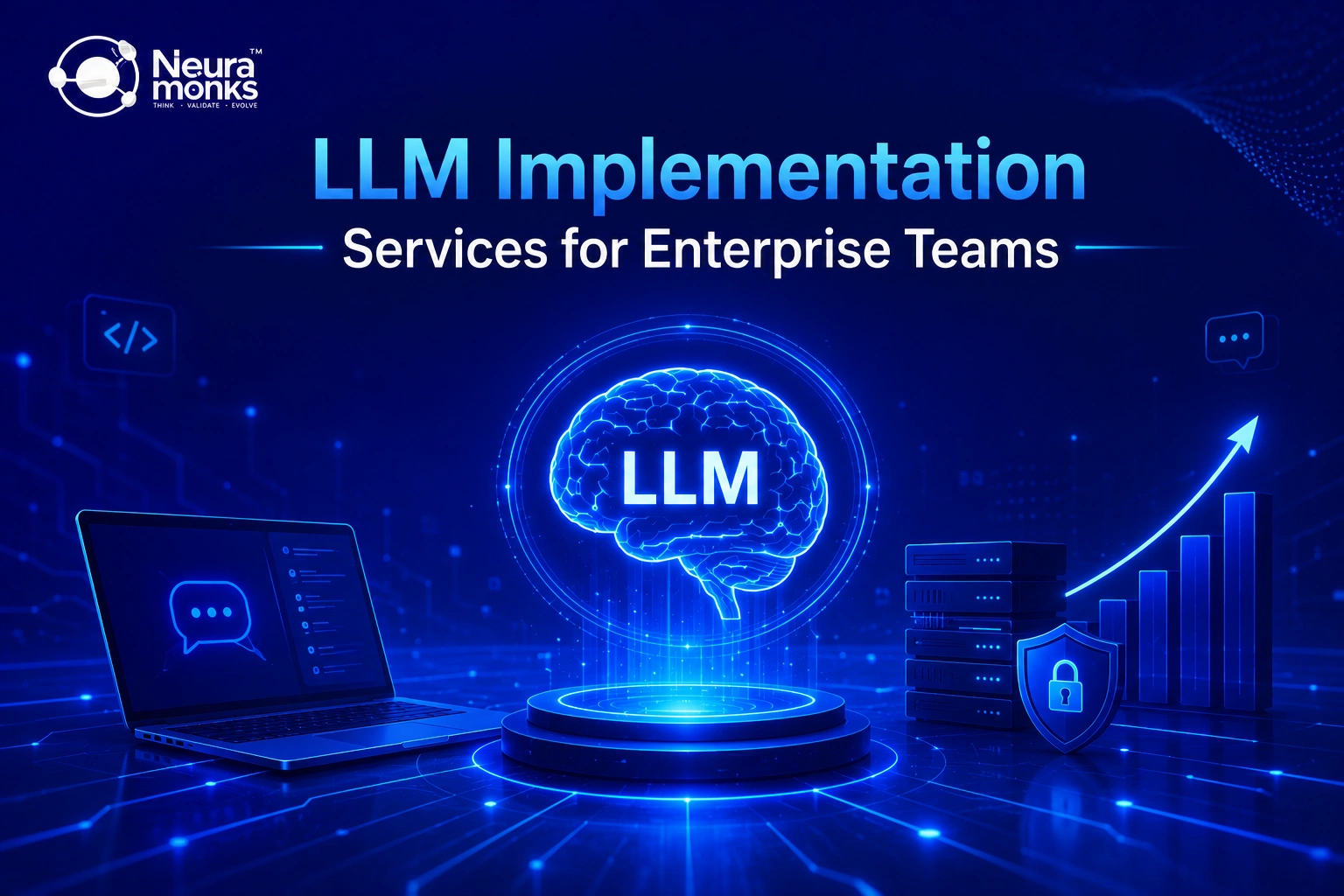
LLM Development for Enterprise: Beyond Chatbots, Built to Scale

A guide to enterprise LLM development beyond chat interfaces covering RAG vs. fine-tuning decisions, multi-agent orchestration, and how to vet an AI agency's PoC discipline and production track record before signing.

Upendrasinh zala

Upendrasinh zala

10 Min Read
All
AI Solutions

Deploying a scalable LLM Solutions requires moving past basic conversational interfaces to build robust infrastructure. Most companies have only scratched the surface of what large language models can do. This guide covers how enterprise teams are using LLMs for far more than conversational AI and what to look for when choosing the agency that will build it with you.

LLMs Are Not Chatbots. They Are Infrastructure

There is a persistent misconception in enterprise buying decisions: that LLM development means building a customer-facing chat interface. This is understandable chat products are the most visible public use case but it misses the deeper opportunity by a wide margin.

In 2026, the most impactful enterprise LLM deployments have nothing to do with conversational UI. They sit silently inside operational workflows, data pipelines, and decision-support systems doing the kind of unstructured reasoning work that brittle, rules-based automation could never handle.

“Large language models are general-purpose reasoning engines. Where your business has unstructured data, inconsistent inputs, or judgment heavy processes, there is almost certainly an LLM application worth building.”

Understanding the full breadth of what LLMs can do and finding an agency that has actually shipped across those categories is the first step to a successful enterprise AI engagement.

What High-Impact LLM Implementations Actually Look Like

The following categories represent real production deployments, not hypothetical use cases. Each one requires a different combination of model architecture, data infrastructure, and integration work.

  • Automated contract review and clause extraction
  • Intelligent document processing and classification
  • Multi-step research and report generation
  • Internal knowledge base Q&A with source attribution
  • Custom media pipelines built on our AI Podcast Generation Platform
  • Clinical notes summarization and coding support
  • Sales intelligence and CRM enrichment workflows
  • Multi-agent orchestration for complex task routing
  • Compliance monitoring and regulatory flagging
  • Personalized content generation at scale
  • Code review, refactoring, and documentation
  • Customer support triage and resolution routing

Micro-Case Study Healthcare

Wound assessment in clinical practice is still largely manual: measurements vary between clinicians, ruler-based methods are error-prone, and the workflow simply does not scale for remote care. Neuramonks built an Automated Wound Detection and Measurement System using an Attention U-Net deep learning architecture. The pipeline detects wounds from standard RGB images, uses a green calibration marker for real-world scale reference, applies perspective correction, and outputs centimeter-accurate measurements of wound area, perimeter, width, and height all via a HIPAA-compatible, API-ready architecture. Clinician measurement effort dropped by 55 to 65%, consistency improved by 30 to 40%, and AI output stayed within 5% error compared to expert manual benchmarks.

Read the full case study →

Micro-Case Study Finance & SaaS · Construction

A real estate and architecture client was losing significant time manually inspecting floor plan images to extract room boundaries, area calculations, and spatial metadata work that was error-prone and impossible to scale. Neuramonks built an AI-powered floor plan extraction system combining computer vision, OCR, and LLM-assisted normalization on AWS. The pipeline auto-detects individual floors, segments rooms, extracts polygon boundaries, and outputs structured, database-ready spatial records without human intervention. Manual analysis effort dropped by 60–70%, dimensional accuracy improved by 30 to 40%, and 100% of outputs are now analytics ready for downstream property and architecture systems.

Read the full case study →

What "Enterprise Grade" LLM Expertise Actually Requires

Not every agency that advertises AI services can execute on complex enterprise deployments. The difference becomes clear when you dig into their architecture decisions, infrastructure experience, and approach to failure modes.

Model Architecture

Ability to design fine-tuned models, RAG-augmented pipelines, and hybrid architectures not just prompt wrappers around hosted APIs.

Infrastructure Depth

Cloud-native deployments with autoscaling, vector database integration, orchestration frameworks, and production monitoring from day one.

Security & Compliance

SOC 2, HIPAA, and GDPR-aligned pipelines with proper data isolation, audit trails, and access controls for regulated industries.

PoC Discipline

Structured AI Proof of Concept Services with defined success metrics, fixed timelines, and clear go/no-go criteria before full commitment.

MLOps Capability

Long-term model monitoring, drift detection, retraining pipelines, and version management because LLMs degrade in production over time.

Vertical Experience

Prior production deployments in your industry. Edge cases and regulatory constraints in finance, healthcare, and SaaS are not learnable on your dime.

Fine-Tuning vs. RAG: Getting the Architecture Right

One of the most consequential decisions in any LLM project is whether to fine-tune a base model or use Retrieval Augmented Generation (RAG). The wrong call here can cost six figures and months of development time.

Fine-tuning modifies the weights of a base model using your own labelled data. It is the right choice when you need consistent tone and domain-specific terminology that cannot be delivered through context injection, or when compliance requirements demand a self-hosted model with no external API calls. For a deeper breakdown on choosing the right model scale for these tasks, see our comprehensive SLM vs LLM guide on the Neuramonks blog.

RAG retrieves relevant chunks from a vector-indexed knowledge base and injects them into the LLM's context at inference time. For most enterprise use cases internal knowledge Q&A, document analysis, product recommendation RAG delivers comparable accuracy at a fraction of the cost and maintenance overhead“An agency that defaults to fine-tuning every LLM without first evaluating RAG is likely over-engineering your solution and billing you accordingly. Push them on this decision during evaluation.”

Sophisticated agencies will often propose hybrid architectures: a RAG system with selective fine-tuning for the retrieval reranker or a domain-adapted embedding model. This is where real LLM engineering expertise becomes visible.

Disclosure: This blog is published by Neuramonks. The comparison below reflects our honest view of the market and where each firm genuinely fits including where competitors have strengths we do not. We believe transparent positioning is more useful than a hidden vendor ranking.

Why Enterprise Teams Choose Neuramonks Over Legacy Consultancies

The gap between global consulting firms and specialist LLM agencies is wide and widening. Here is an honest breakdown of what each type of firm delivers, where they fall short, and who each option is actually right for.

1. Neuramonks

Best for end-to-end LLM implementation across verticals

⭐ Top Pick
Neuramonks was built specifically around LLM and AI automation delivery not as a bolt-on to an existing consulting practice. That focus shows in their approach: every engagement starts with a commercial problem definition, not a technology selection. The question is always "what outcome are you trying to achieve?" before "which model should we use?"

Micro-Case Study Media & Content Industry
A media production client needed to scale podcast output without proportionally scaling their editorial team. Neuramonks deployed a multi-agent LLM pipeline one agent handled topic research via live web retrieval, a second structured and scripted each episode, a third passed output to a text-to-speech synthesis layer. End-to-end production time dropped by 70% (Neuramonks internal client benchmark, 2024), and the platform now runs in production across multiple show formats with no human intervention in the research and scripting stages.

Neuramonks' AI Proof of Concept Services follow a structured framework: fixed 4 to 8 week timeline, real client data integration, measurable success criteria, and a clear go/no-go recommendation. This de-risks the investment before any full-scale commitment is made.

Their core technical stack covers fine-tuned LLM model deployment, RAG pipelines using Pinecone and pgvector, multi-agent orchestration with LangChain and LlamaIndex, and cloud-native infrastructure on AWS and GCP. Active verticals include SaaS, media, finance, and healthcare.

Custom LLM pipelinesMulti-agent workflowsRAG architectureStructured PoC deliverySaaS / Media / FinancePost-deployment MLOps

2. Accenture AI

Best for global enterprise programs with complex legacy integration
Accenture's AI practice benefits from massive scale and deep systems integration capability. Their Azure OpenAI practice is one of the most mature in the industry, and their ability to manage organizational change alongside technical delivery is unmatched at global scale. The trade-off is cost and velocity enterprise programs at Accenture move at consulting pace, and deep LLM engineering depth sits behind significant account management overhead.

Azure OpenAISystems integrationChange managementGlobal delivery

3. Deloitte AI & Data

Best for regulated industries with mature governance requirements
Deloitte's strength in financial services, government, and healthcare stems from their governance and responsible AI frameworks, which are among the most developed in the market. For organizations where AI risk documentation and audit trails are non-negotiable, Deloitte brings credibility. However, their LLM model engineering bench is thinner than specialist agencies, and delivery timelines reflect consulting rates rather than sprint-based product development.

Responsible AI frameworksAWS BedrockRegulated industriesGovernance documentation

4. DataRobot

Best for AutoML + LLM hybrid pipelines in insurance and pharma
DataRobot occupies a useful niche between platform and services provider. Their managed AI cloud handles model training, monitoring, and deployment for enterprises that need production-speed without a deep in-house ML team. Strong for insurance and pharmaceutical use cases where structured prediction and LLM reasoning need to coexist in the same pipeline. Less suitable as a primary development partner for bespoke LLM architectures.

AutoML + LLM pipelinesModel monitoringInsurance / Pharma

5. Weights & Biases (W&B)

Best for ML teams scaling internal research and experimentation
W&B is more accurately described as an MLOps infrastructure partner than a development agency. If your team has strong in-house ML talent but needs experiment tracking, model versioning, and production monitoring tooling, W&B is indispensable. Not suitable as a primary development partner for organizations without existing AI engineering teams you need builders first, then W&B makes them more effective.

Experiment trackingModel versioningML infrastructure

Side-by-Side: LLM Model Capabilities at a Glance

How to Evaluate an LLM Agency Before Signing

Evaluating an AI partner requires the same rigor as vetting any major technology vendor. Here is a structured framework that separates agencies with genuine production experience from those selling innovation-theater.

Ask for production case studies with real metrics

Any agency can spin up an impressive demo with a hosted API and a UI library. What separates real LLM engineers is production experience: handling token limits at scale, managing latency under load, implementing fallback logic when models hallucinate, and maintaining accuracy as the underlying world knowledge shifts. Ask specifically for cost savings achieved, accuracy benchmarks hit, latency SLAs maintained, and user adoption figures not architectural diagrams.

Pressure-test their PoC process

A well-structured AI Proof of Concept Service should include defined success metrics agreed upfront, a fixed timeline of four to eight weeks, integration with your actual data (not synthetic samples), and a binary go/no-go decision framework. If an agency cannot clearly articulate how they structure PoC engagements, they are likely selling exploration at your expense.

Probe infrastructure maturity

Production LLM deployments require more than prompt engineering. Ask about experience with vector databases such as Pinecone, Weaviate, or pgvector; orchestration frameworks like LangChain or LlamaIndex; and cloud-native deployment on Kubernetes or serverless inference endpoints. An agency that cannot answer these questions confidently is unlikely to be enterprise-ready.

Test their fine-tuning vs. RAG reasoning

As covered earlier, fine-tuning is expensive and often unnecessary. Ask the agency to walk through their decision framework: under what conditions do they recommend fine-tuning versus RAG versus a hybrid approach? The quality of this answer reveals whether you are talking to engineers who have thought deeply about trade-offs, or salespeople who will over-engineer whatever maximizes their billable hours.

Ask about post-deployment support

LLMs are not fire-and-forget deployments. As world knowledge shifts and user behavior evolves, model performance drifts. Agencies without MLOps capabilities will leave you responsible for maintenance work your team is likely not equipped to handle. Clarify upfront whether ongoing monitoring, retraining, and performance review are included, and at what cost.

Five Mistakes Enterprises Make When Hiring LLM Agencies

01 Prioritizing flashy demos over production track records

A well-animated prototype tells you nothing about whether the team can handle real data volumes, real users, and real SLAs. Always ask what happened after the demo.

02 Skipping the PoC phase entirely

Jumping from requirements directly to full development is one of the most reliable ways to waste significant budget on AI that never ships. A structured proof of concept changes this equation.

03 Choosing on price alone

LLM model engineering is a specialist skill. The cheapest quote almost always reflects inexperience with production-grade complexity. What you save in fees you will spend in failure costs

04 Ignoring post-deployment operations

LLMs degrade over time as the world changes and user behavior evolves. Agencies without MLOps capabilities leave you managing a system you did not build and do not fully understand.

05 Not aligning on success metrics before the first sprint

Vague briefs produce vague outcomes. Define latency thresholds, accuracy benchmarks, and cost-per-inference targets before any code is written not after the first review cycle.

What LLM Development Actually Costs in 2026

Cost ranges vary significantly by scope, compliance requirements, and infrastructure complexity. The figures below represent typical market ranges across well-known agencies not fixed prices.

The main cost drivers are model selection (proprietary API costs versus self-hosted open-source), vector database and inference infrastructure, compliance requirements for regulated industries, and the depth of integration with existing enterprise systems. AI Proof of Concept Services remain the most cost-effective way to validate ROI before committing to full development scope.

Talk to Neuramonks about your LLM model project

Whether you are scoping AI solutions  for the first time or evaluating your next LLM platform build, our team offers structured discovery sessions. We help enterprise teams define PoC scope, select the right architecture, and put together a business case grounded in real numbers not vendor optimism. AI Proof of Concept Services, production deployment, and ongoing MLOps support: all under one roof.

Book a Free Consultation with Neuramonks

Top AI/ML Companies in the USA Ranked by Innovation & Revenue

Discover the top AI/ML companies in the USA ranked by innovation, revenue growth, and real world deployment success. Explore which firms are delivering measurable business outcomes and shaping the future of enterprise AI in 2026.

Upendrasinh zala

Upendrasinh zala

10 Min Read
All
AI Solutions

Who is actually building, deploying, and delivering ROI at enterprise scale not just talking about it.

The top AI/ML companies in the USA are ranked by their ability to deliver production-grade AI solutions across industries not by pitch decks. In 2026, the leaders are defined by three things: proprietary model development, real client outcomes, and the machine learning solutions that prove ROI at scale. This list breaks down who is actually delivering.

Why This Ranking Matters in 2026

The AI industry crossed a critical threshold in 2025: the gap between companies that talk about AI and companies that build, deploy, and maintain AI systems at enterprise scale became impossible to ignore.

Boards stopped funding AI exploration. They started demanding AI execution. That shift rewrote the competitive landscape and it is why any serious ranking of AI/ML companies must weigh demonstrated outcomes, not claimed capabilities.

This ranking evaluates US-based AI firms on four dimensions: revenue growth, innovation depth (proprietary research vs. API wrapping), deployment track record, and client outcomes across verticals.

The Criteria Behind the Rankings

Before the list, the methodology matters. Too many "top AI companies" rankings are advertiser-funded. This one is not.

Estimated 2024 AI Revenue — Top US Companies

The Top AI/ML Companies in the USA (2026)

OpenAI

Revenue: Estimated $3.4B (2024), growing rapidly toward $10B+ | Innovation: GPT 4o, o1 reasoning model, Sora (video generation), DALL-E 3

OpenAI remains the most influential AI company in the world by research output and enterprise adoption. The GPT API ecosystem powers thousands of downstream applications. Enterprise revenue from ChatGPT Team and Enterprise plans has grown faster than any other segment. The criticisms high compute costs, closed model approach are valid, but output volume and model quality make OpenAI the benchmark every other firm is measured against.

Anthropic

Revenue: Estimated $850M ARR (2024), growing 4x year-over-year | Innovation: Claude model family, Constitutional AI, safety-first research

Anthropic built its competitive position on a specific thesis: that safe AI is commercially superior AI. The Claude model series has demonstrated that enterprise clients care deeply about reliability, predictability, and reduced hallucination risk. Their 100K+ context window and multi-document reasoning capabilities make them the preferred choice for legal, healthcare, and financial enterprise applications.

Google DeepMind

Revenue: Part of Alphabet ($307B 2024 revenue); AI contributes measurably to search, cloud, and ad revenue | Innovation: Gemini Ultra, AlphaFold 3, Gemma (open models)

DeepMind's research output continues to redefine what is possible. AlphaFold 3's protein structure prediction capabilities have direct commercial value in pharmaceutical discovery. Gemini's multimodal architecture and integration into Google Workspace gives DeepMind a distribution advantage that pure play AI companies cannot replicate.

Microsoft AI (with OpenAI Partnership)

Revenue: Azure AI services exceeded $10B ARR in 2024 | Innovation: Copilot ecosystem, Azure AI Studio, phi-3 small language models

Microsoft's AI revenue story is less about model research and more about deployment at scale. The Copilot integration across M365 (Word, Excel, Teams, Outlook) gives Microsoft the broadest enterprise AI surface area in the world. Azure AI Studio is becoming the default deployment platform for Fortune 500 AI initiatives.

Scale AI

Revenue: Estimated $1B+ (2024) | Innovation: Data labeling, RLHF infrastructure, enterprise AI evaluation

Scale AI occupies a critical infrastructure position in the AI stack the quality of training data. Every major foundation model company is a Scale AI client or competitor. Their pivot to enterprise AI evaluation and red teaming services adds a new revenue stream that is growing alongside the AI security market.

Mid-Market Leaders: The Builders Making It Real

The tier below the hyperscalers is where the most interesting commercial AI work is happening. These companies are not building foundation models. They are building the industry-specific applications, custom deployments, and ML pipelines that turn foundation models into operational business tools.

Where We Fit In: Why Neuramonks Focuses on Applied Innovation

We want to be transparent: Neuramonks authored and published this analysis. We are not a multi billion dollar foundation model builder competing with OpenAI or Google DeepMind and we don't pretend to be.

What we do is fill the massive market gap that exists between frontier research labs and the businesses that need to put AI to work. Foundation models are extraordinarily powerful, but they don't arrive pre configured for your revenue cycle, your legal document workflow, or your medical imaging pipeline. That translation layer from raw capability to verified business outcome is where Neuramonks operates.

Our team builds production grade AI systems designed around specific business workflows: computer vision pipelines, NLP document intelligence, predictive analytics engines, and custom model training on proprietary data. The verticals we serve most deeply are healthcare, fintech, legal, and enterprise operations.

The outcomes we document are measurable: cost reductions, process automation rates, accuracy improvements clients can verify independently. We include ourselves in this ranking not to inflate our status, but because the mid market gap we address is real and readers evaluating AI partners deserve to know who actually builds vs. who configures templates.

Healthcare AI Fintech Legal Automation Custom Model Training Computer Vision NLP Pipelines

For an in-depth look at our delivery methodology and vertical case studies, visit our healthcare AI services or fintech AI services pages.

Palantir Technologies

Revenue: $2.87B (2024), 36% growth year over year | Innovation: AIP (AI Platform), Ontology, defense AI systems

Palantir's pivot to commercial AI with AIP has been more successful than most analysts predicted. Their Ontology framework — which creates a live semantic layer over enterprise data gives Palantir a structural advantage in complex data environments. Government contracts remain a revenue anchor, but commercial growth is accelerating.

C3.ai

Revenue: $310M (FY2024) | Innovation: Enterprise AI applications for energy, manufacturing, financial services

C3.ai's recurring revenue model and vertical specific applications give them resilience that horizontal AI platforms lack. Their energy sector applications predictive maintenance, grid optimization, oil and gas analytics are mature and generating measurable client outcomes.

What "Ranked by Innovation" Actually Means in 2026

Innovation in AI has two distinct definitions, and conflating them leads to bad vendor decisions.

Research Innovation: New model architectures, training methodologies, benchmark improvements. This is the domain of OpenAI, Google DeepMind, and Anthropic. Most enterprise buyers do not need research innovation they need the outputs of research, delivered reliably.

Applied Innovation: Taking frontier research and deploying it in production environments that solve real business problems. This is where firms like Neuramonks, Palantir, and Scale AI compete. Applied innovation requires deep domain knowledge, integration expertise, and a disciplined deployment methodology.

When evaluating AI companies, the right question is not "who is most innovative?" It is "who is most innovative for my specific use case?" A company building proprietary transformer architectures is not automatically more valuable than a company that can deploy machine learning solutions against your customer churn data within 60 days.

The Revenue Story: AI Is Now a Profit Center

The narrative shift from 2023 to 2026 is striking. Three years ago, AI was a cost center a research investment with uncertain returns. Today, enterprise AI deployments are generating documented revenue.

Examples from the public record:

  • Companies using AI for demand forecasting report 8 to 14% reduction in inventory costs
  • Firms deploying AI customer service tools see 20 to 30% reduction in support costs
  • Healthcare organizations using AI in revenue cycle management recover 15 to 22% more revenue from previously denied claims

The companies that appear on this ranking — from hyperscalers to specialized builders like Neuramonks are the ones whose clients can point to numbers like these.

Pricing / Cost: What AI Development Actually Costs in 2026

Understanding the cost structure of AI development is essential before engaging any vendor on this list. Pricing varies dramatically by engagement type.

How to Choose the Right AI Partner for Your Business

The ranking above tells you who is building. The question of who is right for your business is different.

Scale of need: If you need to fine tune a foundation model on proprietary data and deploy it across 10,000 users, you need enterprise infrastructure. If you need a specific AI solution built for a defined workflow, you need a specialized development partner.

Domain expertise: AI built by people who understand your industry outperforms generic deployments. A healthcare AI company that has built HIPAA compliant systems is worth more than a general software shop that will learn on your project.

Delivery methodology: Ask for case studies. Ask for client references. Ask what happens when the model underperforms. The answers reveal whether you are dealing with a builder or a salesperson.

Neuramonks offers a direct path to evaluation: contact their team to discuss your specific requirements and review case studies relevant to your industry before any commitment.
FAQs

You asked, we precisely answered.

Still got questions? Feel free to reach out to our incredible
support team, 7 days a week.

How much does it cost to build a custom AI solution?

Projects start under $5,000 for a scoped POC. Full builds range $10,000 $25,000+ depending on complexity, integrations, and scale. We size every engagement to your actual needs.

What's the difference between AI consulting and AI development?

Consulting defines what to build and whether it's worth building. Development is the actual build — models, APIs, data pipelines, and deployment. At NeuraMonks, we offer both as a single engagement, so there's no handoff gap between strategy and execution.

How long does AI development take?

Four to eight weeks from proof-of-concept to production deployment. That's about 50% faster than the industry average. The timeline depends on data readiness, integration complexity, and how much of your existing stack we're working with.

What ROI can I realistically expect from AI?

Clients consistently report 30–40% efficiency gains within the first 90 days and 20–35% reduction in operational costs. Over 90% of our pilot projects reach full production — which means the ROI compounds, not disappears after the demo.

    Can AI integrate with my existing software and workflows?

    Absolutely. We integrate AI into your existing systems via APIs, wrappers, and agents, automating workflows without replacing your stack, cutting manual effort by 30 to 50%.

    Do you work with startups or only large enterprises?

    Both. We work with funded startups and global enterprises. Engagements scale from a focused $5K POC to full enterprise AI platform builds backed by 48+ specialists.

    Is my data safe? Are you ISO certified?

    Yes. As an enterprise AI development company with offices in the USA, UAE, and India, we operate under ISO 27001 certification and SOC 2 compliance. Every engagement is covered by a signed NDA before any data is shared. Your IP stays yours we don't train models on your data for other clients.

    What is Agentic AI and how does it help businesses?

    Agentic AI refers to AI systems that can independently plan and execute multi-step tasks — browsing data, writing reports, triggering actions in other systems without a human managing each step. For businesses, this means entire workflows (research, customer follow-up, reporting) can run autonomously at any hour.

    Explore More

    Book a Free Consultation

    Fill in your project details, we'll handle the rest.

    Response within 24 hours, No sales pitch

    By submitting, you agree to our Privacy Policy. No spam ever. We're ISO 27001 certified & 100% NDA-ready.

    Thank you! Your submission has been received!
    Oops! Something went wrong while submitting the form.